
By MARTY LEVINE
You can take charge of your own stress levels — and of how and whether you use AI.
Those were the twin messages of Staff Council’s annual professional development gathering, Spring Assembly, on May 27, under the theme “Navigating Change: Staying Grounded and Adapting in an Ever-Evolving Workplace.”
“Change is not what we think it is,” said Suzie Bode, a UPMC MyHealth@Work health coach who used the first half of the gathering to speak about steps to lessen the impact of stress. “It is the small little things we do every day. It is creating tools for ourselves.” Those tools can be anything from exercising to gardening, but Bode recommends the easiest one to get started: deep breathing.
“I really do believe that change is possible for every single person on the planet,” she said, if each person has the right support and the right tools.
“We can do it to ourselves as much as the world can do it to us,” Bode cautioned about the cause of stress. “It is a type of energy inside our bodies, and energy cannot be destroyed; it can only change form. It cannot just go away. It has to have an outlet.”
Stress can have many physical, emotional, behavioral and mental symptoms, from pains and sleep disturbance to chronic illness; from sadness to anger; from road rage to wanting to be alone; from forgetfulness to feeling uncreative. “Super annoyed — that is my favorite,” she said of her own experience. “Or you find yourself just feeling stuck in worry. Are you critical of others or of yourself?”
Scrolling on social media should also be on the list of stress symptoms, she said, along with endlessly checking the news. “Same thing with change in the workplace — you’re hoping that it will just settle down.”
Deep breathing, she explained, is one quick “secret weapon for staying relaxed. This is the easiest one for every single human to do, and it is accessible. It is not going to resolve your problem but it changes the level at which you can manage the issue.”
The practice is simple: Place one hand over your diaphragm and your other hand over your heart, to help you feel your heartbeat and how your body moves as you take a deep breath. If your chest is rising more than your stomach, try breathing more from your diaphragm area, she suggested.
“If you need to go and lock yourself in the bathroom and take 30 seconds and take five breaths, and let that belly hand move, I can guarantee... that you will be able to manage that challenge in front of you a little bit differently.” Work, family and political changes — even tech changes such as AI — can feel “out of our control, but I can control my breath.”
All that stress “energy” inside you may need a longer-term outlet, Bode said. Re-engaging with an old interest or taking up a new one — particularly one that involves social contacts — can improve our health. “Those who feel disconnected have a higher risk of stress, anxiety and depression,” she noted.
Make a plan for 14 to 30 days from now, she said, to take up such activities, she suggested: “Take that next step and make a plan — a plan A, B and C, and have each plan be a little easier to do” than the previous one, so that there won’t be any notion of failure, should plan A become impossible.
With AI, you’re still the expert
Making AI work for you, and putting aside the stress of using this new tech development, were twin themes of the second half of Spring Assembly.
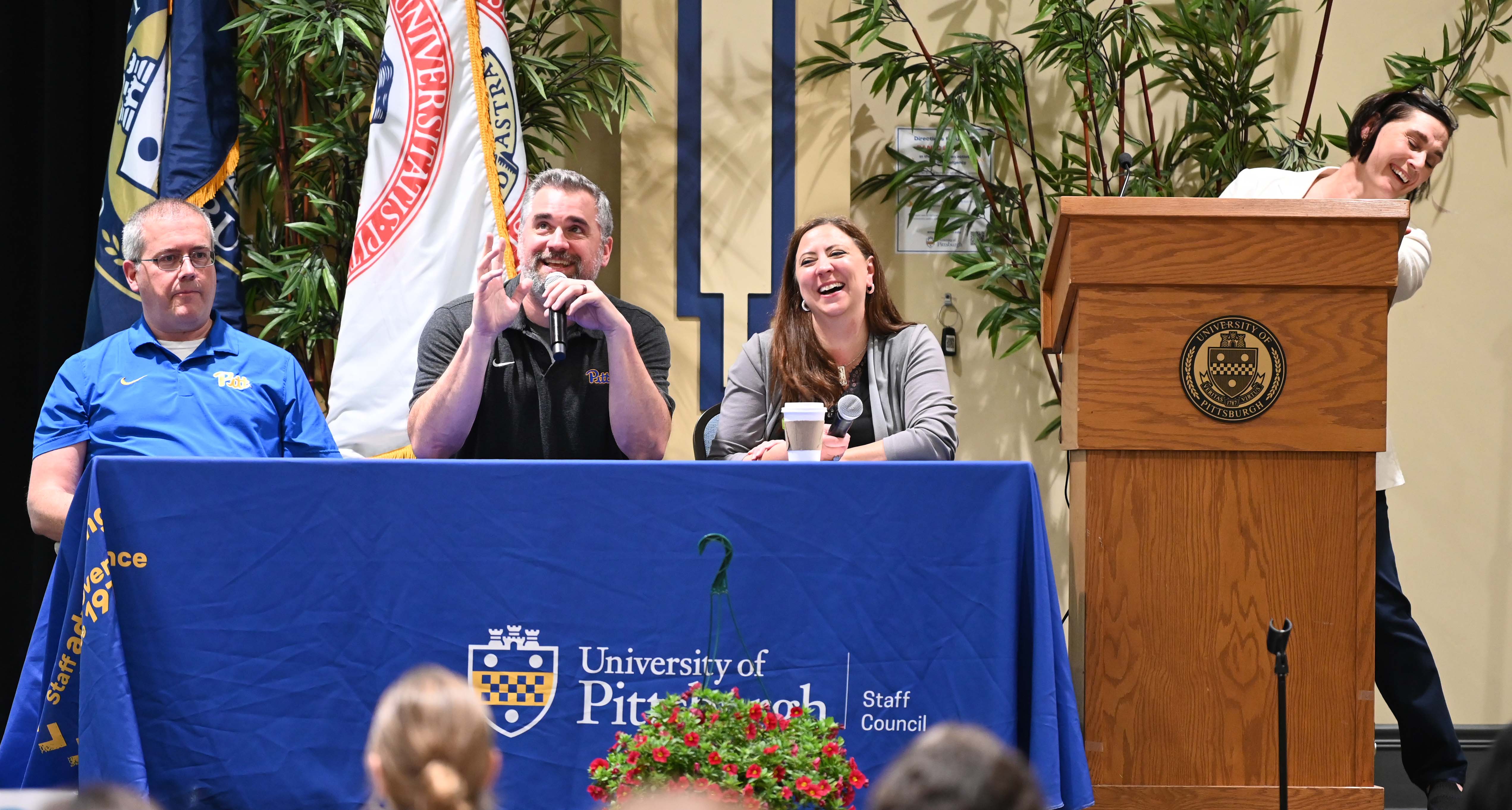
Victoria Lancaster, assistant vice chancellor for operational excellence (and administrator of Pitt’s online AI community of practice), led a panel discussion of Pitt staff who use AI, focused on “fears, concerns and workplace impacts” of the new tech. Even the tech expert on the panel admitted that adjusting to AI can be hard.
“This is new to everybody; it was actually hard” to start using usefully, said Daniel McGaughey on the employee information staff of Pitt Digital. “I had to absorb a lot of knowledge very fast. Now all of us can do it. It’s pretty fun for us.”
“It’s hard to get started on any AI platform,” said Sarah McMullen of Philanthropic and Alumni Engagement (who is also Staff Council’s vice president of public relations): “What do you use it for and what don’t you use it for?” She has learned to approach AI use with a very specific task in mind. And she was helped by more experienced AI users who showed her AI’s possibilities.
Jordan Hoover, director of executive administrative operations for Facilities Management (and chair of Staff Council’s Operations Committee), said he was very skeptical early on that AI would be of any help in his work. But now, when solving “problems on the fly” and faced with a very specific task, he has found it useful to ask AI: “How can I do it faster? How can I do it better? What is the next thing I can do?”
Lancaster also was initially skeptical of AI’s utility for her work, so employed it to help redesign her home kitchen first. But when Pitt adopted Claude AI, she found it to be “a great learning tool. I use Claude all the time to learn something.”
She also realized that Claude can help solve problems it encounters in its own work, although she admits, “sometimes Claude is having a bad day.” She asked the panelists what Claude had done for them that they didn’t know how to do themselves.
McGaughey found out that Claude could splice videos together — a skill he did not yet possess — while McMullen was surprised to see AI suggest and construct a dashboard to present information that she needed to organize. Once, seeing an error message in a Claude-produced item, she asked the program, “What do you suggest? How can we get around this?” and it proposed a solution. “Sometimes they will suggest another platform too,” she said.
“I didn’t have an a-ha moment” in moving from AI skeptic to user, Hoover said. “I just had an ease-into-a-ha. With Claude I realized there was another way of doing it.” He too was surprised to see his usual spreadsheets and Word documents presented as a dashboard by Claude. The inquiry that produced such a result was simply: “How can we make this more interesting?” For further use of AI, Hoover realized he might once have approached it for help with one task, but when he began to ask, “What else can I do, that is where the time saving took place.”
Daniel McGaughey recalled a job he held decades ago, for a company where half the computer staff was writing mainframe computer programs and maintaining them, while the other half — the younger bunch — were focused on new tech. Google had just arrived, but the mainframe crew still had books on their desks — manuals for writing Cobol programs. “It took a long time for people to retrain that muscle to put a question into Google rather than looking at the index of the book,” he said.
“AI is not a search engine. It is a conversation,” Lancaster said — one in which the user keeps asking questions and refining AI’s answers.”
“Take something in your job that takes a lot of your time but not a lot of your expertise,” Hoover suggested, “and try that” with AI’s help.
McMullen observed that AI, for instance, cannot yet design usable crochet patterns, suggesting impossibilities that people who crochet can spot right away. “You’re the expert,” she said.
“You are more important than AI,” McGaughey added. “We do not want to race ahead with these technologies to the detriment of people.”
Marty Levine is a staff writer for the University Times. Reach him at martyl@pitt.edu or 412-758-4859.
Have a story idea or news to share? Share it with the University Times.
Follow the University Times on Facebook.